
← Back to ResourcesBlog
Global Regulatory Updates (March–April 2026): A Simple Guide for Businesses
Maitri Prabhu#Comply2Reg#Regtech#Regulatory Compliance#Regulatory Updates#Compliance Management
Financial regulations across major markets are changing but not in the way many expected. Instead of adding more complexity, regulators in the European Union (EU), United Kingdom (UK), United States (US), and Canada are moving toward simpler rules, reduced reporting burden, and stronger data systems.
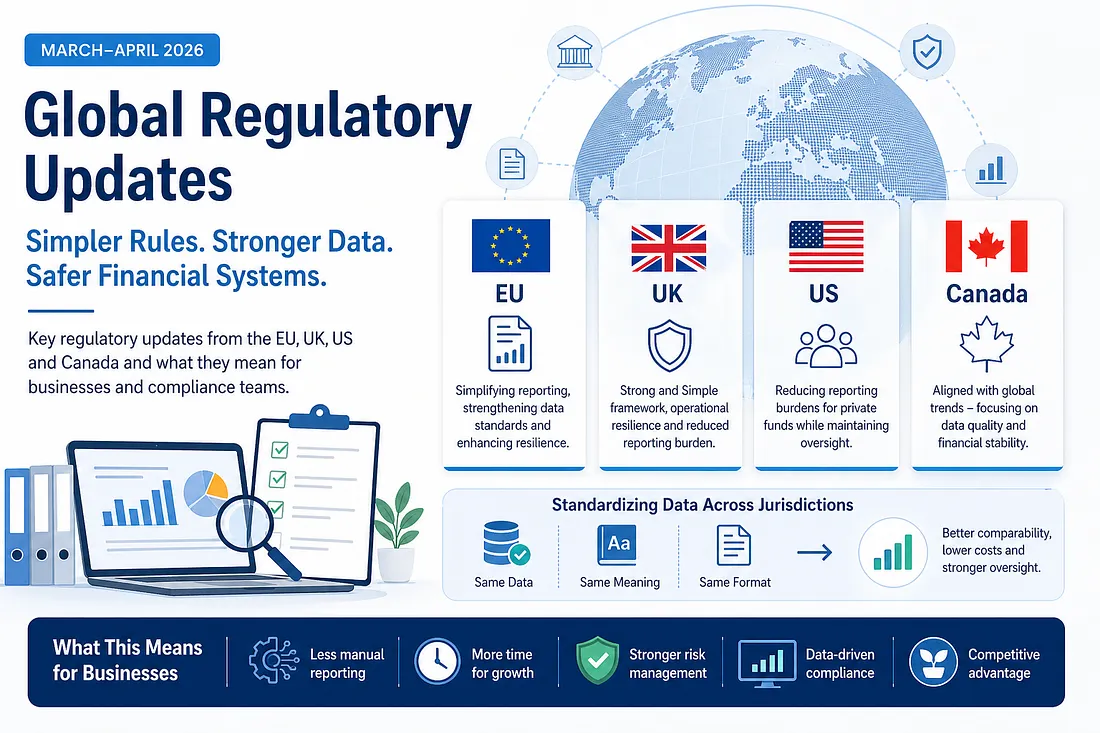
This article explains the latest updates in a clear, practical way so founders, compliance teams, and product builders can understand what’s changing and why it matters.
A Clear Shift: Less Paperwork, Better Data
Across all regions, one theme stands out:
Regulators want less manual reporting and more accurate, structured data.
In the past, companies spent large amount of time preparing reports. Now, regulators are focusing on:
- Reducing duplicate or unnecessary reporting
- Standardizing how data is submitted
- Improving visibility into financial risks
This is not deregulation, it’s smarter regulation.
European Union: Simplifying While Staying Strong
In the EU, key updates are led by the European Banking Authority and the European Securities and Markets Authority.
1. Major Reduction in Reporting Requirements
The EU is proposing to reduce reporting data points by nearly 50%.
What this means:
- Companies will spend less time preparing reports
- Systems will need to be more accurate and automated
- Smaller firms will benefit the most
2. Alignment with Global Standards
The EU continues to follow Basel III standards.
Why this matters:
- Ensures financial stability
- Keeps European banks competitive globally
- Maintains trust in the financial system
3. Focus on Real-World Preparedness
Banks are being tested on how they respond to crises and not just on paper, but in practice.
What regulators want:
- Real planning
- Strong leadership involvement
- Systems that work during stress situations
4. Standardized Payment and Reporting Systems
Efforts are being made to unify how financial data (like payments) is reported across countries.
Result:
- Easier cross-border operations
- Better monitoring of financial activity
- Reduced confusion between jurisdictions
5. New Market Reporting Rules
Under EMIR 3, companies must follow updated reporting formats for derivatives.
Impact:
- More transparency in financial markets
- Better tracking of risk exposures
United Kingdom: Strong, Simple, and Resilient
The UK’s Prudential Regulation Authority has outlined its priorities for 2026–27.
1. “Strong and Simple” Framework
Rules are being tailored based on company size.
What this means:
- Large institutions: detailed oversight
- Smaller firms: simplified requirements
2. Focus on Operational Resilience
Firms must be prepared for disruptions such as:
- Cyberattacks
- System failures
- Market shocks
Goal:
Ensure financial services continue without interruption.
3. Reduced Reporting for Smaller Firms
Smaller firms will report less frequently.
Benefit:
- Lower compliance burden
- More focus on growth and operations
4. Continued Implementation of Global Standards
The UK continues adopting updated frameworks like Basel 3.1.
Outcome:
- Stronger risk management
- Consistency with global markets
United States: Reducing Burden While Maintaining Oversight
In the US, the U.S. Securities and Exchange Commission and the Commodity Futures Trading Commission are simplifying reporting for private funds.
Changes to Form PF
Form PF is used by private fund advisers (like hedge funds).
Key updates:
- Higher thresholds for reporting
- Simplified data requirements
What this means:
- Fewer firms need to report
- Reporting becomes easier
- Regulators still monitor systemic risks
Canada: Quiet but Aligned
While no major announcements were highlighted this month, Canada typically aligns with global regulatory trends.
Expected direction:
- Gradual simplification
- Increased focus on data quality
- Continued financial stability measures
What This Means for Businesses and Startups
These changes are more than regulatory updates, they signal a structural shift in how compliance works.
1. Compliance Is Becoming Data-Driven
Companies must move from:
- Manual reporting → Automated systems
- Static reports → Real-time data
2. Technology Will Play a Bigger Role
Organizations will need:
- Better data infrastructure
- Integrated reporting systems
- Scalable compliance tools
3. Opportunity for RegTech Innovation
This shift creates space for solutions that:
- Automate regulatory reporting
- Standardize data across jurisdictions
- Provide real-time compliance insights
Final Thoughts
Global regulators are sending a clear message:
Simplify the process, but strengthen the foundation.
For businesses, this means less time spent on repetitive reporting but greater responsibility to ensure data is accurate, consistent, and reliable.
Organizations that invest early in data systems and automation will not only stay compliant but also gain a competitive advantage.
#Comply2Reg#Regtech#Regulatory Compliance#Regulatory Updates#Compliance Management